
Ewincher is an advanced and smart electric winch handle that we have tested in the past years with full satisfaction. Today, we’re testing the new version, improved and upgraded, during our “1,000-mile cruise in the Tyrrhenian Sea” that is touching the most beautiful islands of the Tyrrhenian Sea, from Tuscany to Sicily, from Sardinia to Corsica. The new Ewincher 2 is even more performing and faster than its predecessor.
Ewincher 2 on test
 The Ewincher 2 electric winch handle has arrived. On the eve of our departure, we check the contents of the box. Well-stored and protected, we find a semi-rigid bag that holds everything we need to use it: two battery packs and a 220 V charger. We immediately mount the battery which, sliding on two rails on either side of the body of the handle, goes into two connectors, vice versa it is extracted by simply pressing a button on the side.
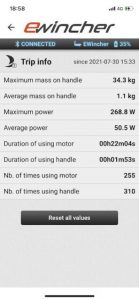
We install the 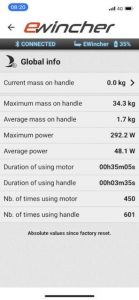 App (available for all operating systems) with which we can set various parameters, such as rotation speed and torque force, and check the state of charge. The first time we use it, the App asks us to enter some date to register as a user, including the boat type and size, the size and brand of our winches with their diameters, in order to automatically adapt the torque. With the app, we can also monitor the maximum effort exerted with some statistical entries, as well as limiting the pull according to three force ranges, 15, 23 or 36 kilograms (23 kg is the standard). Very intuitive and easy to use, the app is available in English.
We set sail from Varazze and head for La Spezia, the first stop of our cruise, and we immediately mount the Ewincher 2 electric handle on the winch. The handle is fitted with the same type of attachment as the traditional handles, and is released by pressing a lever at its base.
The wind is just a few knots, we sail close-hauled and immediately test the handle on the genoa; we discover that the same lever also activates the electric system, a green light comes on and warns us that we are in “low speed” mode. Low speed is suitable for the fine trim of the sails, so it is suitable for current sailing but, if we need more speed, to switch to maximum rotation we simply press the small button on the handle. In that case, the LED turns blue (you can reverse the default speed from the app) and the genoa will cock in an instant. In any case, the power button is a progressive type, so we can modulate the speed precisely according to need and effort.
More power available
 Ewincher 2 is 20% more powerful than its predecessor. In fact, we are also testing it on the genoa upwind in a strong wind and it can haul taut very quickly, perhaps even with more power than a traditional handle. There is no need to switch it off after use, it switches itself off after a certain time.
The handle offers three modes of use: electric, manual and combined. Electric operation is as described above. Manual operation, instead, is activated simply by holding down the speed change button and turning like a manula handle. Combined operation, on the other hand, exploits the speed of the electric motor combined with that of the manual rotation: to be used when you need to retrieve long lines quickly, if they do not have too much tension. When the tension increases and the clutch starts to slip, you can switch to electric mode only or to manual mode as seen above.
There are many uses we are covering on our cruise with the Ewincher 2, such as effortlessly rolling sails or hoisting a man over the masthead. The light bulb for the anchor light at the masthead no longer lights up: what better occasion to test the Ewincher 2 to get on? I put on my harness, we use one halyard as the main and one as a safety halyard, handle on the winch and off we go. The Ewincher 2 is set at 23 kg, let’s try to see if it can do it, I weigh 73 kilograms… it pulls me up with ease, on high speed it has no hesitation and apparently works effortlessly, no fatigue for Luca who used the handle. The speed of the ascent and the modularity of the power provided by the progressive button are perfect for climbing in safety.
I access the App to check the status of the battery, and it turns out that only 10& has been consumed. Ewincher 2 is proving to be a good ally on board, frugal in its consumption, and an extremely valid and economical alternative to replacing manual winches with electric ones.
The only effort required, therefore, is that of counteracting the rotation due to the action/reaction: a much more limited effort because it is static compared to the rotational movement required to operate the winch. During our cruise, we use the Ewincher 2 electric winch handle mainly to open and close the mainsail, which is the operation that requires the most effort.
But it is during the three 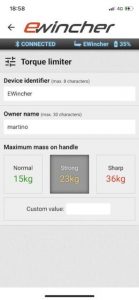 transfers from the Aeolian islands to Palermo, from Palermo to San Vito Lo Capo and from the latter to Sardinia that we fully test performance and durability. The battery is at 100%, having been charged in less than an hour and a half since the last 15% discharge. We use it to unfurl and furl the sails, for fine-trimming, for long mainsheet retrievals during gybes and also to launch and haul the tender. The speed is amazing, especially in the combined action.
We try to set the maximum force to 15 kg: the handle simply stops when the force required reaches this value, then it is sufficient to select the next value, 23 or 35 kg, to increase the power. At the end of the three transfers, we check the charge status: 35% of the battery still remains, the maximum force delivered was 34.3 kilograms, almost the maximum of the 35 setting, and the power reached 292.2 W.
How the Ewincher 2 is made
Construction is rigid plastic, technically fibreglass reinforced with Polyamide 12, which is stronger than aluminium, with soft rubber protections for the keys: the handle is not buoyant but is IPX6 certified water proof. Weighing only 2.2 kg, it is also quite compact; it has a length of 250 mm, identical to that of the manual handles.
The 450 W electric motor transmits 230W of mechanical energy to the rotor: the company’s calculations show that a well-trained man can supply 200 W of mechanical force for just 30 seconds, and then the power decreases with fatigue. The torsion force provided by the handle is up to 90 Nm, which corresponds to 36 kg in the hands of the operator who, for proper use, will have to assume an appropriate position to counteract the pull.
The rotation speed can vary from 0 to 100 rpm, adjustable with the progressive pressure of the button. The battery is the second most important element after the brushless motor: it is a lithium ion battery of 3,000 mAh, 75.6 Wh and ensures a full day’s use. It can be recharged very quickly using the dedicated 220V charger, with a full charge taking only an hour and a half. The special construction technology of these batteries ensures at least 4 years of use.
Previously published articles
April 2021: EWINCHER 2: THE NEW MORE POWERFUL ELECTRIC WINCH HANDLE
June 2018: ON TEST. EQINCHER: THE STATE-OF-THE-ART ELECTRIC WINCH HANDLE
May 2018: EWINCHER: THE ELECTRIC WINCH HANDLE